
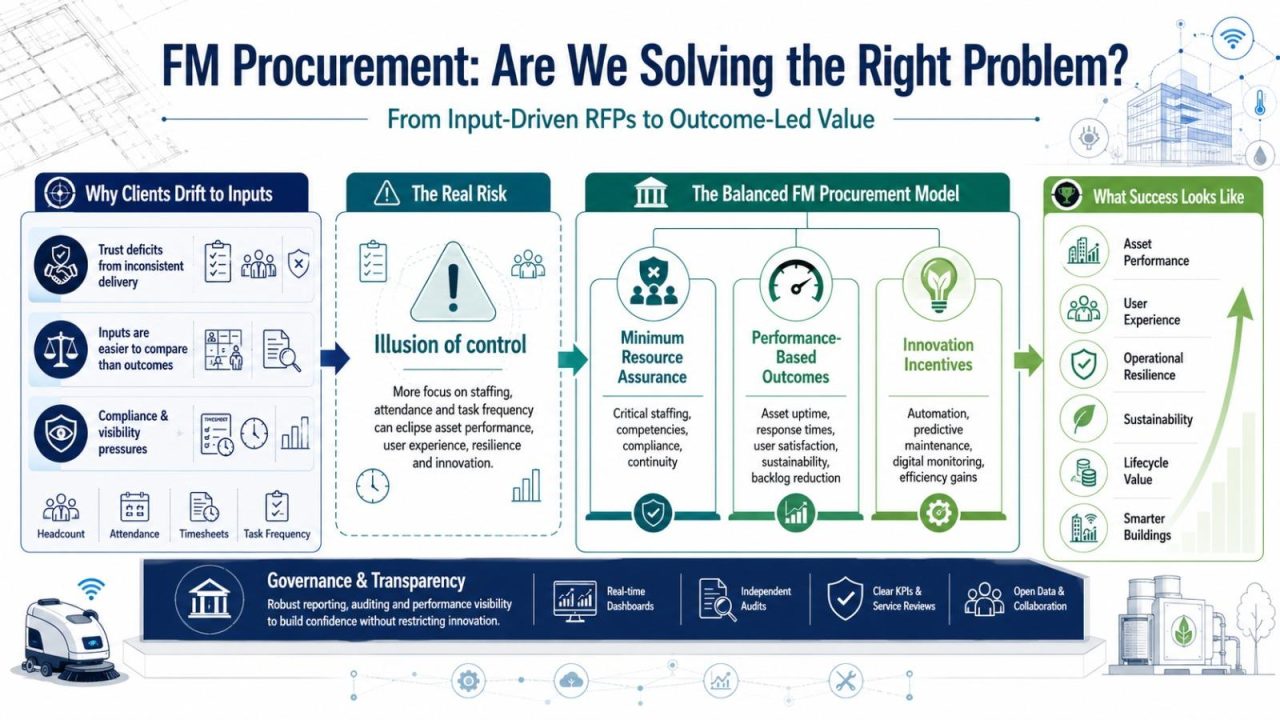
In recent years, a noticeable trend has emerged across the Facilities Management industry, where clients are increasingly moving away from outcome-based procurement models and returning to highly input-driven Requests for Proposals (RFPs). It is indeed alien to an IFM regime and undermines the very business case for clients to migrate from traditional operations and maintenance (O&M) formats. Due to these specifications, which should otherwise focus on service outcomes, asset performance, user experience, and operational resilience, they are now dominated by detailed requirements on workforce numbers, staffing structures, frequencies, attendance, and prescriptive task execution, interfering with the core spirit of FM’s output-based rationale.
At first glance, this shift appears understandable if it really cuts costs, but this is not the case when we look at long-term cost analysis; this approach has seldom served its purpose. I fully appreciate that clients are operating under growing pressure to control costs, improve visibility, ensure compliance, and, as a critical aspect, reduce perceived service risks stemming from trust deficits arising from service providers’ past experiences. Still, this is a short-sighted approach, and time and again it has proved that FM impacts get eclipsed in input-driven environments. The question remains: are we solving the right problem, or are the clients merely taking control by creating an illusion of control over themselves and their organization?
Though I agree that the rise of input-driven contracting is not accidental, it is largely driven by several legitimate concerns.
- There is a simmering issue that many organizations are experiencing: inconsistent service delivery from FM providers. In some cases, aggressive underpricing, inadequate supervision, and poor workforce deployment have created trust deficits between clients and service providers. When outcomes fail, clients naturally seek greater control over inputs.
- The procurement departments often find the workforce easier to evaluate than performance outcomes. Comparing headcounts, shift patterns, and resource allocations appears more tangible than assessing service quality, asset reliability, or workplace experience. Also, the lack of mature performance measurement frameworks in some organizations makes output-based contracting more challenging. If outcomes cannot be accurately measured, clients tend to default to measuring activities instead.
- The increased compliance and governance requirements have encouraged clients to seek greater transparency over deployed resources. Particularly within government, healthcare, education, and critical infrastructure sectors, visibility over staffing levels is viewed as a risk mitigation mechanism.
While these concerns are understandable, excessive input-based contracting has unintended consequences. For instance, Facilities Management was never intended to be a staffing business. Its fundamental purpose is to optimize asset performance, improve user experience, ensure business continuity, enhance sustainability, and protect long-term asset value. When contracts become excessively focused on inputs, the conversation shifts away from these strategic objectives.
- In the long run, IFM contracts post-mobilization and transitions achieve service stability that helps to reduce staffing deployments with role and service integrations and knowledge progression.
5 . Another related context is that output models are expected to continuously seek better ways to deliver the same or better results through improved processes, technology, training, and data analytics, whereas input-driven contracts often discourage these efficiencies because any reduction in workforce is perceived as a reduction in service, even when performance improves
- The real casualty is innovation. When providers are contractually locked into predefined workforce levels and prescriptive task frequencies, opportunities for technology deployment, automation, robotics, predictive maintenance, digital monitoring, and process redesign become severely constrained. Providers are effectively paid to maintain inputs rather than improve outcomes.
The challenge is misaligned incentives. A contract that rewards the presence of resources rather than the achievement of outcomes creates an environment in which compliance becomes more important than performance. Teams focus on demonstrating that tasks were performed rather than proving that objectives were achieved. It also contributes to the service provider’s inability to leverage digital transformation fully. The FM industry is rapidly evolving through artificial intelligence, IoT sensors, smart buildings, robotics, predictive maintenance, and integrated command centers. These technologies fundamentally change how services can be delivered. Excessively prescriptive contracts can unintentionally lock organizations into yesterday’s operating models while paying tomorrow’s costs.
I want to emphasize that clients should know that input-based models often fail to answer the most important question: Is the facility performing better, beyond facilities’ upkeep?
A building can have 100% human resource deployment while simultaneously suffering from poor user satisfaction, declining asset reliability, high energy consumption, growing maintenance backlogs, and deteriorating workplace experiences. How often do clients look at productivity beyond attendance logs?
The future, therefore, should not be viewed as a choice between input-driven and output-driven contracts. The answer lies in balance. A mature FM procurement model should combine the strengths of both approaches.
Clients are justified in seeking assurance regarding minimum resource levels, critical competencies, regulatory compliance, and business continuity requirements. There could be exceptions for certain environments, such as airports, hospitals, data centers, utilities, and critical government facilities, that may legitimately require minimum staffing thresholds. However, these should represent baseline safeguards rather than the primary measure of success.
The majority of contract performance should be linked to measurable outcomes. These may include asset availability, service response times, user satisfaction scores, energy performance, sustainability targets, compliance performance, maintenance backlog reduction, workplace experience metrics, and overall lifecycle asset preservation.
A balanced FM contract should therefore be built around three key pillars:
Minimum Resource Assurance – Clearly defined minimum staffing and competency requirements for critical services.
Performance-Based Outcomes – KPIs linked to service quality, asset performance, user experience, and business objectives.
Innovation Incentives – Mechanisms that reward productivity improvements, technology deployment, automation, and efficiency gains.
Above all, I agree that Governance and Transparency should be the key bottom line, with robust reporting, auditing, and performance visibility to provide client confidence without restricting innovation.
Having delivered over a hundred global contracts for nearly two decades, I can say with confidence that the most successful FM partnerships globally are built not on counting people but on measuring value. Boards and executive leadership increasingly care about resilience, operational continuity, sustainability, workplace experience, and asset optimization. These outcomes cannot be achieved through staffing schedules alone.
Facilities Management is ultimately a business outcome enabler, not a labor deployment exercise. While inputs remain important, they should serve as the foundation rather than the destination. The industry must resist the temptation to equate activity with performance and instead focus on what truly matters: creating safer, more efficient, more resilient, and more productive built environments.
The future of FM procurement belongs not to those who specify every input, but to those who intelligently define the outcomes they seek and empower capable partners to deliver them.