
The Case for an Intelligent Asset Ecosystem
Over the years, in many of my writings, industry conversations, and leadership reflections on the evolution of Facilities Management in the Middle East, I have consistently emphasized one recurring challenge confronting our industry: the silent erosion of operational intelligence across the lifecycle of built assets.
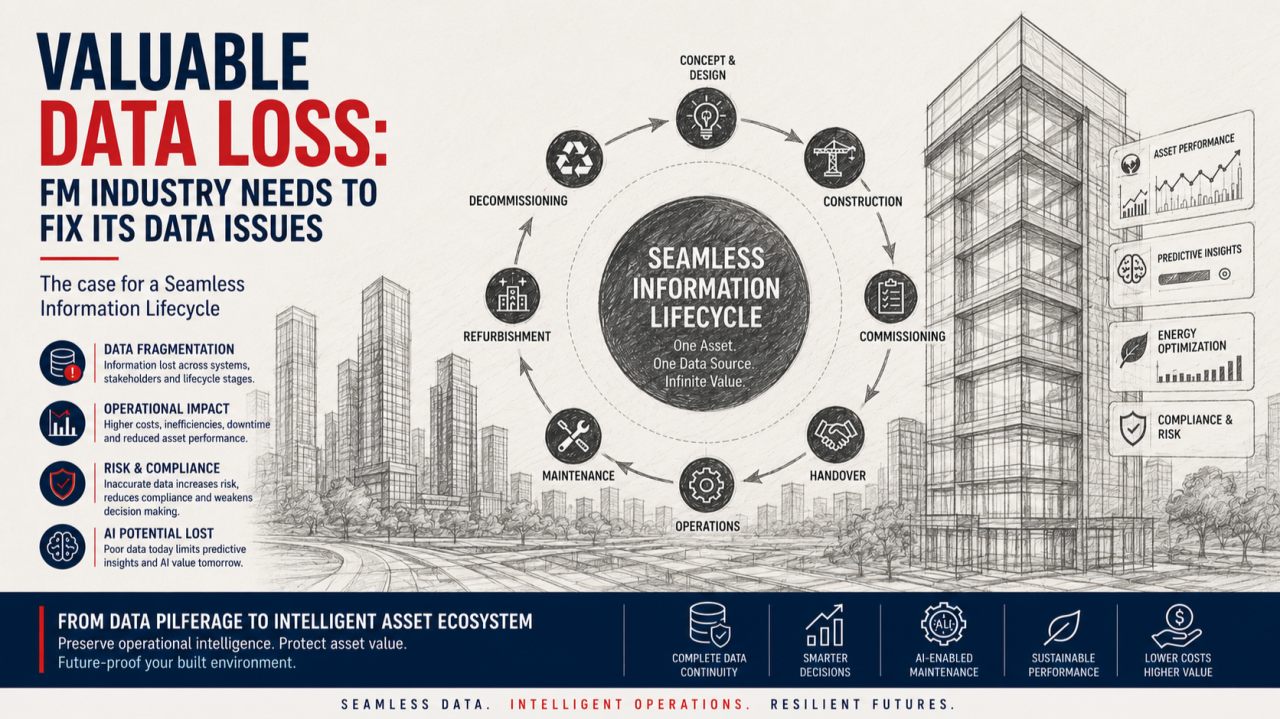
Today, the built environment industry continues to suffer from one of its most persistent inefficiencies – the fragmentation and loss of critical data across the Facilities Management lifecycle. If we are to truly leverage the power of AI to address some of the industry’s most critical challenges, this is undoubtedly one of them. From concept design to construction, commissioning, operations, maintenance, refurbishment, and eventual decommissioning, information travels through disconnected systems, incompatible platforms, siloed stakeholders, and inconsistent standards. The consequence is not merely operational inconvenience. It is the steady destruction of lifecycle intelligence, efficiency, resilience, and enterprise value.
The FM industry in the Middle East is particularly exposed to this challenge because of the scale, velocity, and complexity of development across the region. From giga-projects and smart cities to airports, healthcare ecosystems, hospitality assets, industrial zones, and mixed-use communities, the region is creating some of the most sophisticated built environments in the world. Yet despite this technological ambition, lifecycle data continuity or migration remains one of the weakest links in the operational chain.
The irony is striking. Buildings are becoming smarter, yet operational data remains fragmented. This gap is doubling the woes of maintenance and widening its issues. For instance, in many built environments, data between CAFM and BMS systems is not integrated, leading to duplication of effort, productivity loss, and other problems that eventually impact the FM goals.
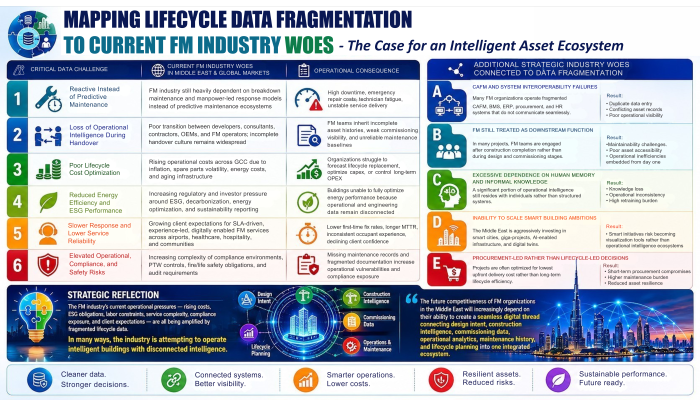
In many projects today, data generated during design and construction rarely transitions seamlessly into operational FM environments. Valuable engineering intent, BIM models, commissioning records, warranty documentation, equipment histories, maintenance parameters, energy baselines, and testing reports are frequently lost, duplicated, or manually recreated during handovers. Based on my experience, in two out of three cases, asset list integrity is highly compromised due to either erroneous or incomplete data. This does not end here; we continue to see this issue with commissioning and testing. This data, though, is quite essential to the building handover compliance process, but it still gets lost because of multiple data handover processes.
The commissioning-to-operations transition remains perhaps the most vulnerable point of failure. Large volumes of information from consultants, OEMs, subcontractors, and commissioning agents are handed over in inconsistent formats – PDFs, spreadsheets, disconnected CAFM exports, archived folders, and email trails that rarely evolve into usable operational intelligence. By the time FM teams assume responsibility, they often inherit incomplete asset registers, inconsistent tagging conventions, fragmented maintenance records, and missing contextual engineering history.
Even in existing built environments, it is hard to find relevant maintenance data. Rarely do we find cases where past data is made available in its entirety. This issue is much broader than even in the case of conditional surveys, refurbishment, or capital works, or, for that matter, financial information. For example, BIM, which was originally envisioned as a lifecycle intelligence platform, often becomes little more than a construction-stage compliance deliverable rather than a seamless integration into the operations and maintenance phase.
This forces operations teams into reactive maintenance regimes rather than predictive and intelligence-led maintenance environments. Engineers spend unnecessary hours physically verifying assets because digital records cannot be trusted. Preventive maintenance schedules are often built on assumptions rather than equipment-specific lifecycle intelligence. Mean time to repair increases, first-time fix ratios decline, asset lifespan deteriorates, and operational expenditure escalates. In this specific problem, I do agree that maintenance regimes also need to transform their mindsets away from manual and verbal communication toward digital and process automation, but the aforementioned issues also contribute to the problem.
In the Middle East, where climatic conditions place extraordinary stress on critical MEP infrastructure, the consequences are even more severe. Energy-intensive assets operating in extreme temperatures cannot afford fragmented lifecycle data. The downstream impact on sustainability, ESG targets, occupant experience, and operational resilience becomes substantial.
I have often argued in earlier publications and industry forums that the future of FM will not merely be defined by manpower scale or operational delivery capability, but by the industry’s ability to harness integrated operational intelligence across the entire lifecycle of the built environment. Facilities Management can no longer remain a downstream recipient of asset information that otherwise should be an integral part of a seamless data transition with zero tolerance for data integrity in the migration process. FM must become an embedded stakeholder from project inception itself. This requires a fundamental shift from project-centric thinking to lifecycle-centric thinking.
The emergence of Digital Twins in AI-enabled maintenance ecosystems, IoT integrations, predictive analytics, and interoperable CAFM platforms presents a transformative opportunity for the industry. This is where seamless data integration matters. When integrated effectively, these technologies can create continuously synchronized asset ecosystems where design data, commissioning records, live operational parameters, maintenance histories, and energy performance data coexist within a unified operational framework.
However, technology alone will not solve the problem. The real barriers remain governance, interoperability, contractual structures, and industry culture that I touched upon earlier.
Seamless data integration must be embedded into procurement frameworks, project specifications, commissioning protocols, and operational contracts from the outset. Clients must demand structured, machine-readable lifecycle data rather than static handover documents. Open interoperability standards such as IFC, COBie, BACnet, MQTT, and ISO 19650-aligned information management frameworks must become operational necessities rather than optional aspirations.
Equally important, the FM industry itself must elevate its role within the built environment value chain. For FM professionals to participate earlier in design reviews, digital governance structures, and maintainability assessments, this indeed requires the responsibility of building owners and developers. They need to ensure early engagement and elevate the FM’s role in commissioning strategies and lifecycle planning.
Above all, FMs need to rise above zero data loss across the routine maintenance regime, where data must not be limited to SLA logs but also include all contract performance information, plus any critical machine data used to support maintenance, especially in the context of ensuring AI-driven value.
Facilities Management is not merely about maintaining assets after handover. It is about preserving operational continuity, protecting asset intelligence, enabling sustainability outcomes, and safeguarding long-term enterprise resilience. The industry often speaks about intelligent buildings, sustainability, AI, and smart infrastructure. Yet none of these ambitions can be fully realized when the very foundation of operational decision-making, reliable lifecycle data, remains fragmented. The data loss is not a technological inevitability. It is a collective industry failure of continuity, accountability, and foresight.
If our industry is to truly aspire to lead the next generation of smart, resilient infrastructure, then seamless information continuity across the entire FM lifecycle must become a strategic priority. Every asset should arrive at every stage of its life with its full operational intelligence intact. The future of FM will belong to organizations that preserve operational intelligence seamlessly across the entire asset lifecycle.