
Building Organizational Prudence in Margin-Sensitive Facilities Management Industry
The Facilities Management industry, particularly in regions where we have a significant presence, such as the Middle East and South Asia, operates under constant market headwinds, with margins remaining tight and cost pressures persistent. Even before the recent unprecedented developments, the FM sector has been navigating sustained pressure on profitability and operational efficiency.
Contracts are won competitively with razor-thin margins, whilst clients continue to push for performance visibility. With minimum wage regulations evolving, inflation reshaping cost structures, and infrastructure costs rising due to delayed payment cycles, the industry has to adjust to these realities. In such a landscape, cost goalposts rarely remain static. Considering these factors as the new normal, FM companies have to innovate and position themselves accordingly to manage them as routine rather than exceptions.
I believe there is a structural misunderstanding about the above factors; volatility is not episodic, it is embedded in FM. Therefore, lean and agility are key to managing such ecosystems, where the word ‘lean’ is a culture, not just a cost-cutting exercise. It is an architectural discipline that prepares the organization for recurring pressure.
Lean Must Not Be a One-Off Initiative During Austerity
Organizations must not speak about efficiency only when the business is stable. But the true character of a lean organization is revealed when a major contract undergoes mid-cycle repricing, wage costs increase without immediate client recovery, scope compressions reduce billing, mobilization costs exceed projections, payment delays stretch working capital, or, for that matter, any punitive financial pressures due to the client’s strict SLA adherence.
During such moments, organizations must not react emotionally by centralizing authority, abruptly freezing hiring, squeezing frontline teams, or layering additional approvals. The way forward in such situations is to respond structurally by reviewing processes, upending SLA adherence, eliminating waste, accelerating decisions, and reinforcing financial discipline without destabilizing people. The difference lies in whether lean was embedded before pressure arrived.
Case Study: When Margin Compression Tested Our System
Let me illustrate with a practical experience. We were managing a large multi-site FM contract across several assets, wherein the contract cost was competitively priced to secure entry into a strategic client portfolio.
Just two quarters into operations, the company faced external pressures, including significant wage revisions that increased manpower costs, and scope rationalization by the client, leading to reduced billing and deferred payment cycles. This unprecedented situation put us in a quandary, with the projected margin compressing by nearly 35%.
The instinctive industry response would have been predictable: reducing manpower, freezing developmental costs such as L&D, or escalating centralization through layered approval controls.
We resisted that path. Instead, we treated it as a stress test of our lean architecture by taking the following steps.
Step 1: Diagnosing Structural Waste Before Cutting People
Rather than reducing frontline staff immediately, we mapped operational friction by reviewing and reducing redundancy in reporting lines between site and cluster levels, procurement approvals, reactive maintenance tasks increasing overtime, unmeasured idle time in specific shifts, and supervisory bandwidth overlaps.
The aforesaid measures helped enable the process simplification alone to recover nearly 8% efficiency within six weeks of that review, without reducing headcount.
Through this exercise, we learned that waste hides in systems before we prune manpower costs.
Step 2: Financial Transparency at Site Level
Historically, many supervisors have operated without visibility into margins. Under pressure, this creates confusion and defensive behavior. We made a deliberate shift.
We brought Supervisors into frontline site management by engaging them in calm, transparent, and analytical, yet non-accusatory, reviews of cost baselines, productivity expectations, overtime sensitivity, and material consumption thresholds.
Something important happened. Once supervisors understood the financial context, they began proposing shift redesigns, equipment pooling, preventive maintenance clustering, and optimization of consumable usage.
This is where we learned how ownership replaced anxiety. Within one quarter, supervisor-driven efficiency initiatives delivered an additional 6–7% recovery.
Step 3: Simplify Leadership Layers Before Operational Compression
Margin pressure often exposes management bloat. We reviewed overlapping reporting roles, excessive management time on approvals and meetings, and any functional duplications.
We knew that selective structural simplification would help management focus and reduce overhead drag. The signal was clear: Lean begins at the top, not just repeating the mistake of attacking the frontline cost. We made sure that our frontline teams recognized that leadership was sharing the burden structurally, not merely transferring it downward.
Step 4: Protect the Non-Negotiables
Despite pressure, we refused to compromise on our core deliverables in service excellence, training, and compliance standards for safety and reporting.
We were cautious not to reduce the above adherences at any cost. We treated them as resilience anchors. Lean culture requires courage to protect foundations during austerity. We remained careful not to resort to any short-term savings in these areas, which often leads to long-term reputational damage or operational risk.
Step 5: Accelerate Decision Architecture
We were diligent to ensure that the commercial stress must not slow decision making, as this amplifies losses, so we redefined procurement authority thresholds, from variation approval timelines, to escalation clarity with weekly margin review dashboards.
This helped us reduce decision latency, ensuring that, in such volatile environments, speed is a cost-control mechanism.
Outcome of the Case
Within two quarters, margin compression stabilized, efficiency gains offset nearly half the cost shock, no major cultural deterioration occurred, supervisor engagement improved, and client confidence was significantly strengthened by the transparency our team provided.
Our real victory was that our team and organization did not panic, as our lean approach had absorbed volatility without destabilizing the system.
Lessons from the Case
Lean is preventative, not corrective. When systems are weak, cost shocks create chaos. Financial transparency empowers rather than frightens, and mature communication builds ownership. Process simplification must precede manpower reduction, with structural waste eliminated first. Leadership credibility and shared sacrifice sustain cultural stability. Above all, composure is a leadership discipline. This also teaches us about the necessity for calmness in being lean, as panic spreads faster than inflation.
Organizational Prudence as Cultural DNA
Over the years, as an organization, we realized that lean becomes less about cost and more about culture. Prudent organizations must ensure:
This also teaches us about the necessity for calmness in being lean, as panic spreads faster than inflation.
- Stress-test budgets before a crisis
- Avoid over-layering during growth.
- Maintain overhead vigilance even in good times.
- Invest in digital visibility early.
- Build supervisor capability continuously.
Lean cultures assume volatility as they are designed for volatility. And therefore, in such cultures, there are not many aftershocks.
The Deeper Cultural Shift
Ultimately, lean culture in Facilities Management is about shifting identity from reactive operator to structured steward; from cost controller to system architect; from margin defender to resilience builder. When this shift occurs, austerity no longer defines the organization. It tests it and strengthens it.
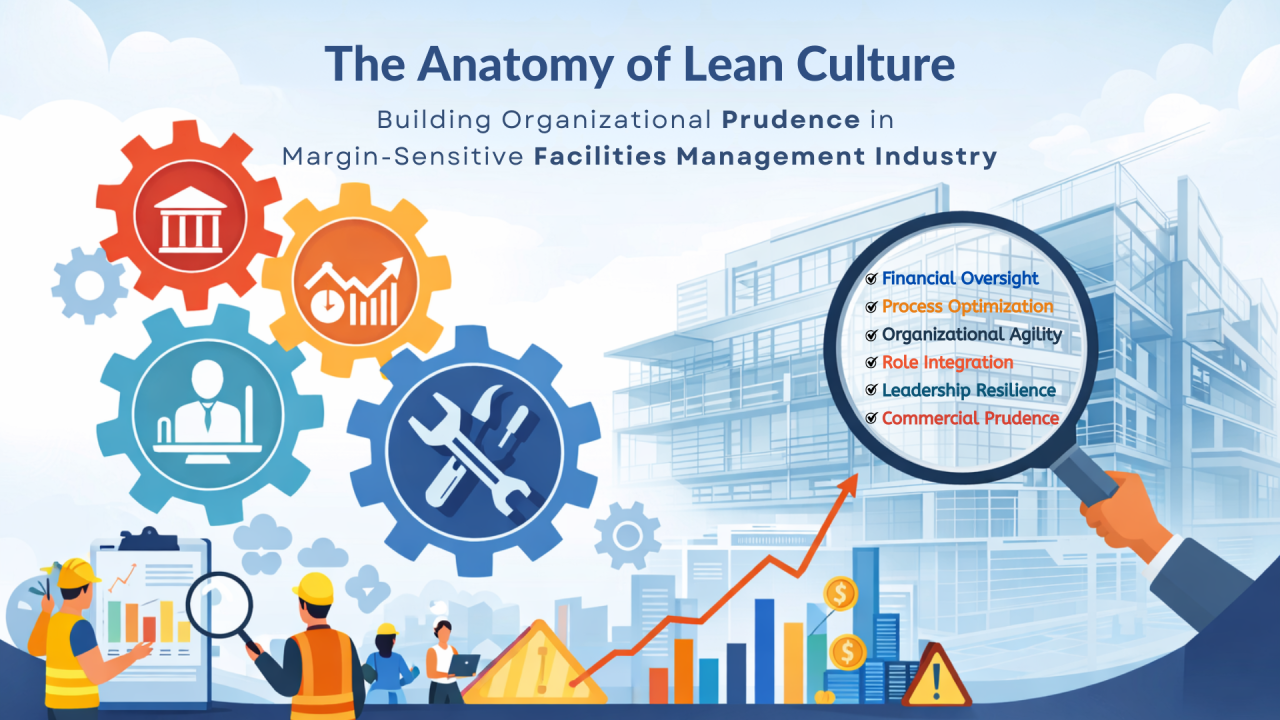
The Anatomy of Lean Culture in FM
In its most distilled form, lean culture in Facilities Management rests on six interdependent pillars:
- Financial Oversight: Clarity of financial visibility
- Process Optimization: Process discipline without rigidity
- Organizational Agility: Fast decision-making
- Role Integration: Structural simplicity in leadership layers
- Leadership Resilience: Calm, principled leadership under pressure
- Commercial Prudence: Embedding financial sustainability in mainstream organization goals
When these coexist, the organization becomes structurally prudent. And prudence is the quiet strength that sustains service excellence in margin-sensitive environments.