
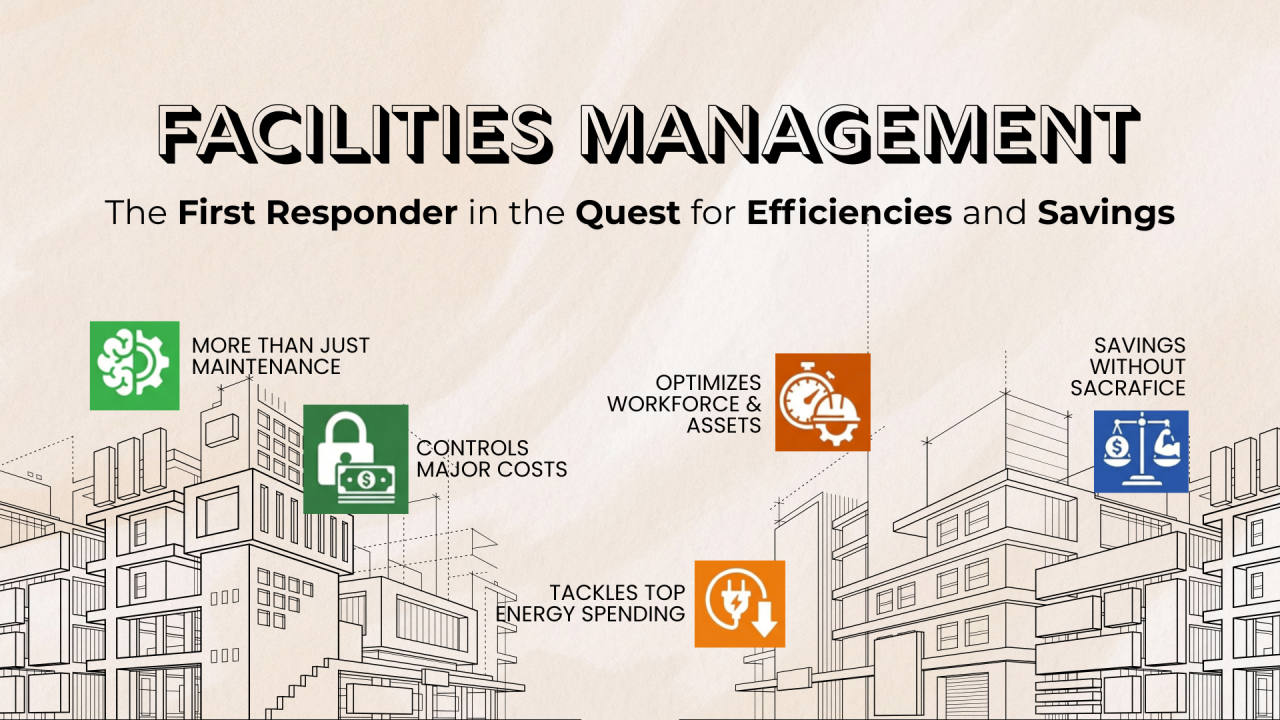
For long, I have been advocating the colossal role that Facilities Management plays in bringing cost efficiencies and operational prudence, especially in periods when enterprises and economies are compelled to recalibrate their spending priorities. Across global markets — or within a specific region or country — moments arise when governments, companies, landlords, and tenants must look inward and reassess how every riyal or dollar is being spent. This need to embrace FM applies at all times—whether during subdued market conditions or periods requiring broader austerity measures—when the instinctive response is to focus on cost containment without compromising business continuity. It is in these defining moments that Facilities Management, often understated and working away from the spotlight, emerges as the true first responder. Long before restructuring conversations begin or workforce adjustments are considered, FM quietly steps forward, stabilizing operations, identifying efficiencies, and creating value with a steadiness that few other business functions can match.
FM has long been typecast as a support service, operating behind the curtain while the visible engines of commerce command attention. Yet those who understand the built environment know that FM is, in fact, the custodian of an organization’s operating ecosystem. It determines how efficiently an enterprise lives, breathes, and performs. And in today’s world, FM’s role extends far beyond traditional service lines. It encompasses the full building lifecycle, workplace productivity, sustainability, space optimization, waste management, and recycling. These expanded mandates are not mere add-ons; they represent the new frontier of FM evidenced by the CAGR the industry has recorded over the past few years. Its evolving role in delivering cost efficiencies, particularly with austerity looming and economic headwinds becoming more pronounced, has never been more critical. More organizations are now embracing FM not merely as a maintenance function, but as a transformative framework that drives process optimization, services integration, supply chain consolidation, and long-term asset resilience.
Since FM models inherently possess the ability to innovate, redesign workflows, and engineer efficiencies, they can enhance their own margins while simultaneously increasing value delivery to clients. This dual benefit — enhancing internal performance while uplifting client outcomes — is one of FM’s most powerful differentiators.
FM becomes the natural point of intervention because it governs some of the largest controllable expenses in any organization. Energy consumption, maintenance regimes, manpower utilization, cleaning productivity, asset uptime, and service levels all fall squarely within FM’s sphere. In times of economic contraction, these areas offer both the greatest risks and the greatest opportunities. When managed with discipline, they become levers for sustainable cost correction rather than reactive cutting.
The true value of FM in cost-sensitive periods lies in its ability to generate savings without compromising business continuity. FM-driven efficiencies are scientific, data-led, and operationally sound. The first fundamental step is always ensuring asset reliability. A well-maintained asset operates at higher efficiency, consumes less energy, and demands fewer emergency interventions. Spare parts control, predictive maintenance, and lifecycle planning ensure organizations avoid the spirals of downtime, operational disruption, and avoidable financial leakage.
Energy management remains one of FM’s most immediate impact zones. Anyone reviewing their service-charge composition recognizes that energy is usually the largest cost line. In a high-cost and sustainability-conscious landscape, FM professionals deploy smart metering, retrofits, automation, and behavioral change strategies that deliver measurable reductions in consumption. These interventions are not only cost-saving mechanisms; they reflect a responsible, environmentally aligned operating philosophy that enhances organizational resilience. Even simple measures — recalibrating HVAC systems, optimizing lighting cycles, improving insulation — unlock meaningful value at scale, especially in periods of austerity.
Manpower optimization is another core lever. FM uniquely understands how to redesign deployment without weakening service quality. Through multi-skilling, route planning, digital productivity tools, and lean operating models, FM improves output per resource while maintaining service delivery. This disciplined approach helps enterprises avoid blunt cost measures such as indiscriminate headcount reduction, which often degrade performance.
Enhanced governance can drive contractual discipline, vendor management, and compliance oversight. FM provides the structure to re-evaluate service levels, renegotiate commercial terms, eliminate redundancies, and embed transparency. With FM’s holistic view of the asset ecosystem, every expenditure aligns with essential needs rather than being dissipated through fragmented processes.
For landlords and tenants, FM becomes the mediator and stabilizer in the value chain. Rental yields, service charges, and operating expenses come under scrutiny. Effective FM ensures service charges reflect true value. Transparency, efficiency, and operational alignment build trust — enabling landlords to preserve asset value while ensuring tenants experience functional, well-managed facilities without inflated costs.
Governments depend on FM in the same way. Public-sector efficiency cannot risk interruptions in essential services. FM offers a structured, safe, and accountable pathway to rationalization — through energy retrofits in hospitals, lifecycle optimization in schools, and productivity uplift in public assets. FM becomes the operational bridge between fiscal policy and on-ground delivery.
The core strength of FM lies in its steadfast ability to balance financial prudence with operational resilience. It does not cut for the sake of cutting; it guides organizations to spend wisely, eliminate waste, and elevate performance. Those who understand FM’s full potential emerge stronger, leaner, and more future-ready.
FM is, and has always been, the first responder, driving efficiency. The myth of viewing FM as an additional cost driver is a misnomer. It is the stabilizer during disruption, the silent architect of system-wide resilience, and the enabler of sustainable value creation across every economic cycle.